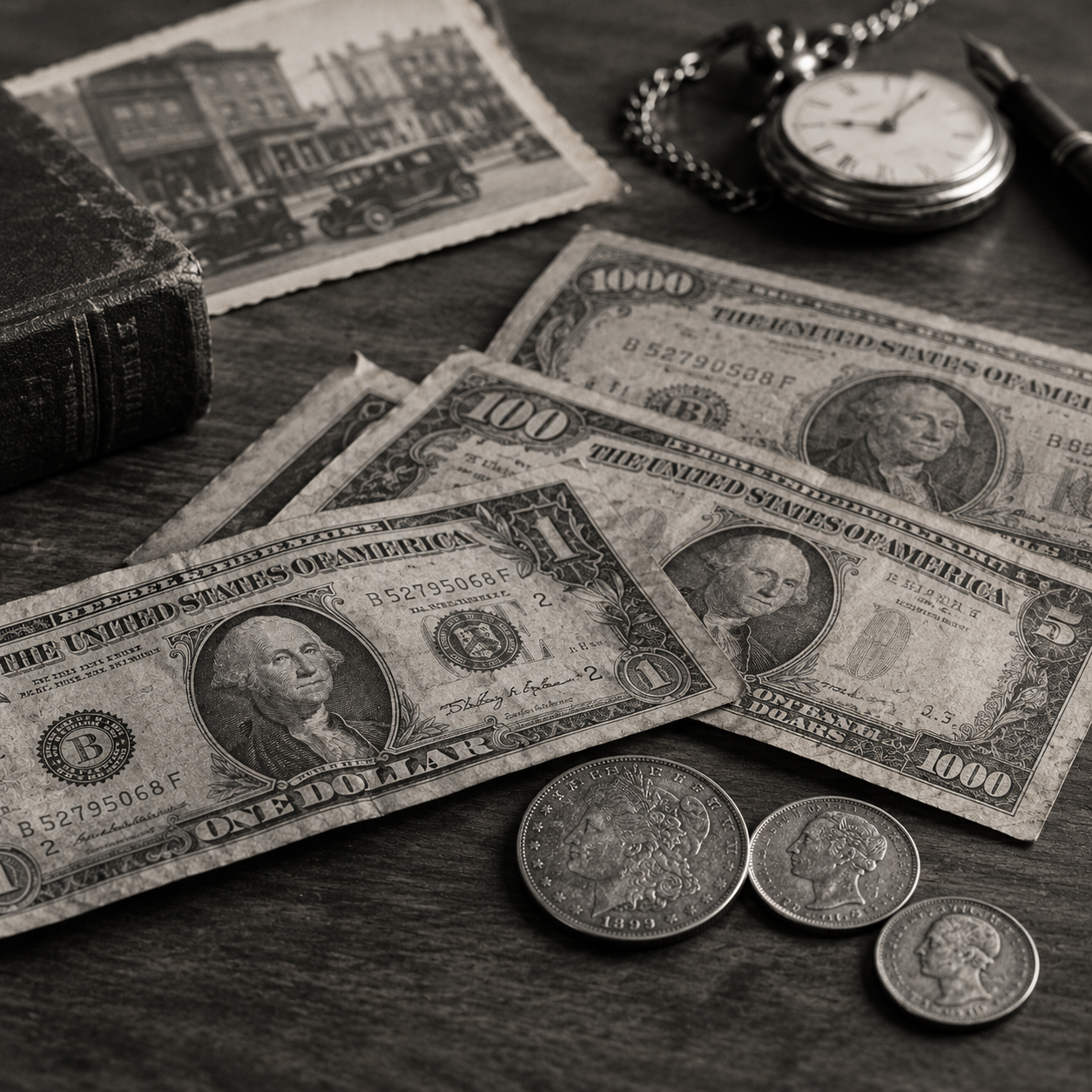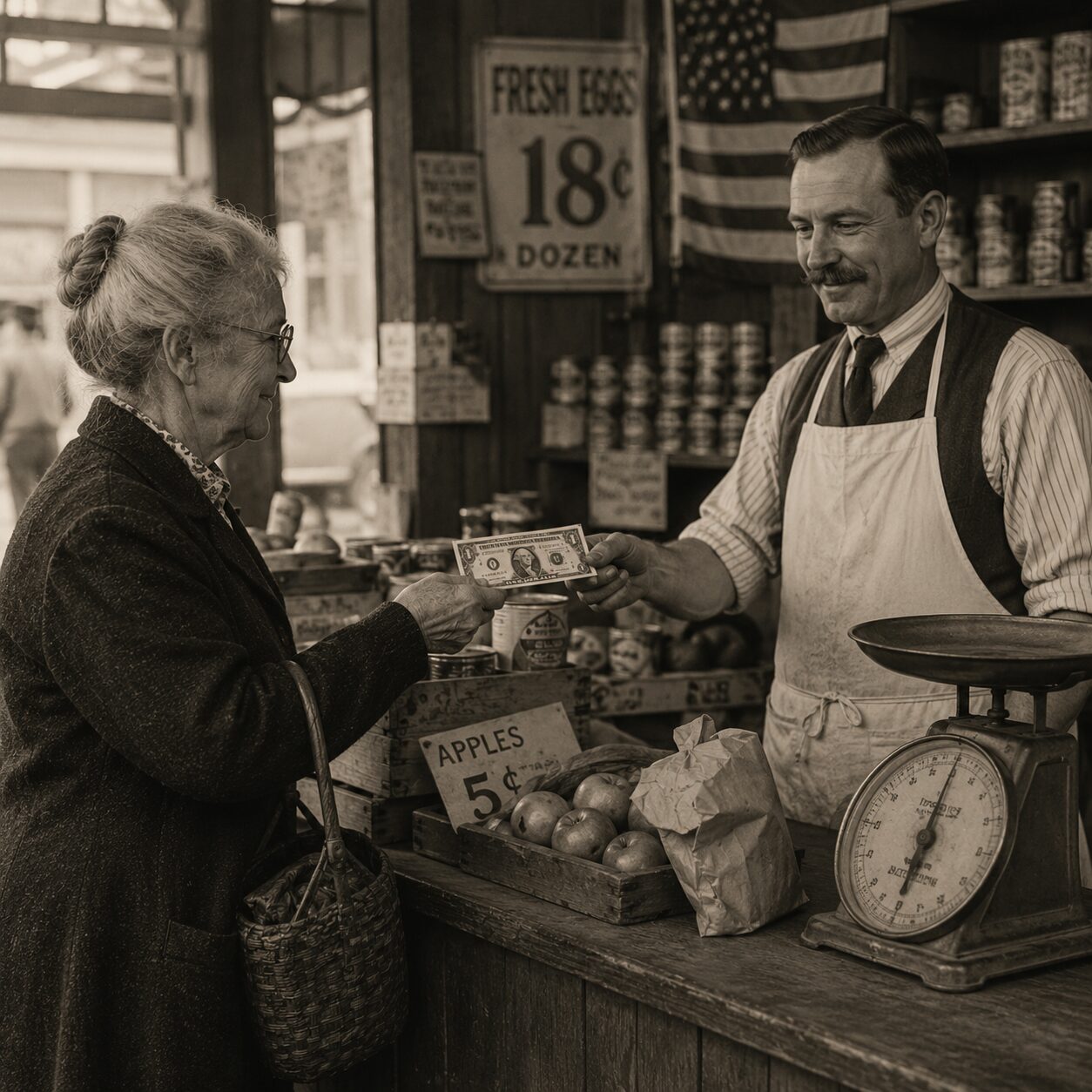
Imagine walking into a store in 1900 with just one dollar in your pocket. Today that dollar barely buys you a piece of candy, but back then it had the purchasing power of roughly $35–$40 in modern money. What your great-grandparents could accomplish with a single bill is both astonishing and humbling — a reminder of just how dramatically inflation has reshaped everyday life over the past century.
1900 Money Worth Today

Why $1 in 1900 Was Serious Money
The United States in 1900 was a country of hard labor and modest wages. The average American worker earned around $400–$500 per year — meaning a single dollar represented a meaningful chunk of a day’s pay. Prices were low not because life was cheap, but because wages were even lower. Every cent was counted, stretched, and respected in ways we can barely imagine today.
20 Things Your Great-Grandparents Could Buy for $1 in 1900
1. A Full Week’s Worth of Bread
A standard loaf of bread cost around 5 cents in 1900. For just one dollar, a family could stock their bread box for the entire week and still have change left over. Bakeries were neighborhood staples, and fresh bread was a daily essential for nearly every household across America.
2. Ten Pounds of Sugar
Granulated sugar was priced at approximately 6 cents per pound in 1900. One dollar bought you nearly ten full pounds — enough to last a household for weeks of baking, preserving, and sweetening morning coffee. Today, a five-pound bag of sugar costs roughly $4 or more, putting 1900’s pricing in stark perspective.
3. A Pound of Butter
Butter was a pantry staple priced at about 25 cents per pound in 1900. For a dollar, your great-grandmother could bring home four pounds of fresh butter — enough for pies, biscuits, and pan-frying all week long. Quality dairy was a point of household pride in early 20th century America.
4. A Dozen Eggs
Eggs averaged around 12 to 14 cents per dozen in 1900, making them one of the most affordable protein sources available. A dollar would land you nearly eight full dozen — almost 100 eggs. Families kept backyard chickens precisely because eggs were currency in daily cooking and bartering.
5. Five Pounds of Flour
All-purpose flour ran about 2 cents per pound, meaning a dollar bought a hefty 50-pound sack in some regions. Flour was the backbone of home cooking — breads, gravies, biscuits, cakes, and pie crusts all depended on it. Households bought it by the sack, not the bag, because they used it every single day.
6. A Pound of Coffee
Ground coffee cost approximately 15 to 20 cents per pound in 1900. A dollar could get you five or six pounds of coffee — enough to keep a family caffeinated for weeks. Coffee was prepared on the stovetop in percolators or boiled directly, and it was one of the few luxuries working families allowed themselves.
7. A Movie Ticket (With Change)
Nickelodeons — the early movie theaters of the era — charged just 5 cents for admission. For one dollar, a family of four could each see four films and still walk out with money in their pockets. Early silent films were a revolutionary form of entertainment, drawing audiences from all walks of life.
8. A Hot Meal at a Diner
A full plate of food at a working-class lunch counter or diner typically cost between 10 and 15 cents in 1900. One dollar covered a hearty sit-down meal for six or seven people — soup, a main course, and bread included. Diners and lunch counters were the fast food of their era.
9. A Streetcar Ride — Many Times Over
A single streetcar fare in most American cities cost just one penny to five cents in 1900. A dollar could fund a month’s worth of daily commuting in some cities. Streetcars were the dominant form of urban transportation, threading through every major American city long before the automobile took over the roads.
10. A Pound of Steak
Beef prices varied by cut, but working families could purchase a pound of steak for around 12 to 15 cents. A dollar bought enough beef to feed a large family a proper Sunday dinner. Butcher shops were neighborhood institutions, and customers knew their butcher by name and trusted him with the week’s meat order.
11. Two Gallons of Fresh Milk
Milk was sold by the quart and cost roughly 6 cents in 1900. A dollar would bring home several gallons of fresh, unpasteurized milk delivered straight to your door by the milkman. Milk delivery routes were a fixture of American life, with glass bottles exchanged daily on front porches across the country.
12. A Full Day of Manual Labor
In 1900, unskilled laborers earned between 10 and 15 cents per hour. A single dollar represented six to ten hours of backbreaking work on a farm, in a factory, or on a construction site. This context alone illustrates why people saved carefully, wasted nothing, and stretched every dollar until it nearly tore.
13. A Child’s Pair of Shoes
Simple children’s shoes could be found for around 75 cents to one dollar in 1900 through mail-order catalogs like Sears, Roebuck & Co. A dollar bought practical, sturdy footwear built to last through seasons of wear. Shoes were repaired rather than replaced, and a cobbler was as essential to a neighborhood as a pharmacist.
14. A Pound of Tobacco
Pipe tobacco and chewing tobacco were common purchases for working men and ran approximately 10 to 20 cents per pound. A dollar filled a generous tobacco pouch that lasted for weeks. Smoking culture in 1900 was deeply embedded in social life — tobacco was shared at general stores, saloons, and on front porches after the workday ended.
15. A Haircut
A barber’s chair in 1900 cost around 10 to 15 cents for a standard haircut and shave. One dollar was good for six or seven visits — more than a month’s worth of grooming. Barbershops were social hubs where men gathered not just for haircuts but for news, gossip, and community conversation.
16. A Postage Stamp — 40 of Them
In 1900, a first-class postage stamp cost just 2 cents. A dollar bought 50 stamps, enough to send weekly letters for nearly a year. Letter-writing was how families stayed connected across distances, and the postal service was a lifeline for millions of Americans separated by immigration, migration, and work.
17. A Spool of Thread and Sewing Notions
Thread, buttons, and basic sewing notions were just a few cents each in 1900. A dollar outfitted a seamstress with everything needed to mend, patch, and stitch for months. Most women in 1900 sewed clothing at home out of necessity — store-bought garments were a luxury reserved for the middle and upper classes.
18. A Small Bottle of Patent Medicine
The patent medicine industry was booming in 1900, and bottles of tonics, elixirs, and cures sold for 25 to 50 cents each. A dollar bought two or three bottles of whatever remedy promised relief — regardless of whether it actually worked. These colorful cure-alls were sold door to door and through catalogs before modern medical regulation existed.
19. A Pound of Candy
Penny candy was exactly that — one cent per piece. A dollar bought 100 individual candies, or a full pound of mixed sweets from the general store jar. Candy shops and confectionaries were community institutions, and a dollar spent on sweets was considered a genuine indulgence for families who budgeted every purchase carefully.
20. One Night at a Boarding House
In 1900, a modest boarding house room in a small city or working town cost between 50 cents and one dollar per night, sometimes including a basic breakfast. A dollar gave a traveling worker a safe bed, a roof overhead, and a meal to start the morning — everything needed for a night’s rest on the road.
What Does $1 from 1900 Equal Today?
According to historical inflation data, $1 in 1900 is equivalent to approximately $36 to $40 in 2024 dollars, depending on the measure used. That means your great-grandparents’ grocery list that cost $5 would run you close to $200 today. The math is staggering — and it’s a direct reflection of over a century of inflation, monetary policy changes, two world wars, and the shift from a gold-backed currency to a modern fiat system.
The Real Lesson Behind the Numbers
What this list reveals isn’t just about money — it’s about the texture of daily life in 1900. People ate locally, bought simply, repaired instead of replaced, and made every dollar count. The purchasing power of that single bill was real and tangible in ways that shaped every household decision. Understanding this history doesn’t just satisfy curiosity — it reframes how we think about value, frugality, and the economy we live in today.
FAQS
Q1. What is 1900 money worth today?
When we talk about 1900 money worth today, $1 from 1900 is equivalent to approximately $36 to $40 in modern dollars, depending on the inflation measure used. That staggering difference reflects over 120 years of rising prices, economic expansion, two world wars, and the abandonment of the gold standard that fundamentally changed how money holds its value.
Q2. How much was $100 in 1900 money worth today?
Understanding 1900 money worth today means recognizing that $100 in 1900 would be worth somewhere between $3,600 and $4,000 in current dollars. That was an enormous sum for any working family at the time — equivalent to nearly an entire year’s wages for a laborer — making it a genuinely life-changing amount of money in the early 20th century.
Q3. Why has money lost so much value since 1900?
The primary driver behind 1900 money worth today comparisons is inflation — the steady rise in prices over time. Factors like government spending during major wars, the shift away from the gold standard in 1971, population growth, and increased consumer demand have all contributed to the dollar losing roughly 97% of its purchasing power since the turn of the century.
Q4. What could the average American buy with $1 in 1900?
Looking at 1900 money worth today reveals just how far a single dollar stretched back then. With $1, a person could buy a full week’s worth of bread, several pounds of sugar, a dozen eggs, a pound of coffee, or even enjoy multiple hot meals at a local diner — purchases that would easily cost $30 to $50 or more in today’s economy.
Q5. How did wages in 1900 compare to the cost of living?
When studying 1900 money worth today, it’s important to understand that wages were extremely low by modern standards. The average unskilled worker earned around $400 to $500 per year. While prices were low, the ratio of wages to expenses left little room for savings or luxury — meaning that even though a dollar went far, earning that dollar required tremendous physical effort and long working hours.
Q6. What was the average salary in 1900 in today’s money?
Adjusting for 1900 money worth today, the average annual wage of roughly $450 in 1900 translates to approximately $16,000 to $18,000 in modern dollars. That figure sits well below today’s federal minimum wage on an annual basis, highlighting how dramatically living standards and earning power have shifted over the past century for the average American worker.
Q7. How is 1900 money worth today calculated?
Economists calculate 1900 money worth today using the Consumer Price Index, which tracks the changing cost of a standard basket of goods and services over time. By comparing what the same basket cost in 1900 versus today, researchers can determine how much purchasing power has been gained or lost. The Bureau of Labor Statistics provides historical CPI data going back to the late 1800s.
Q8. Was life more affordable in 1900 than today?
The concept of 1900 money worth today suggests prices were dramatically lower, but affordability is more nuanced. While bread cost 5 cents and eggs were 12 cents a dozen, wages were also razor thin. Modern workers enjoy significantly higher real wages, better benefits, and access to goods and technologies that simply didn’t exist in 1900 — making direct affordability comparisons more complex than raw price numbers suggest.
Q9. How much was a house worth in 1900 compared to today?
Real estate is one of the most striking examples of 1900 money worth today. The average American home in 1900 cost around $3,000 to $5,000. Adjusted for inflation, that equals roughly $110,000 to $180,000 today — yet actual home prices in most American cities far exceed that figure, meaning real estate has appreciated even beyond the rate of general inflation over the past 125 years.
Q10. What was $5 in 1900 worth in today’s money?
Putting 1900 money worth today into perspective, $5 in 1900 had the purchasing power of approximately $180 to $200 in modern dollars. For a working-class family in 1900, $5 was a substantial sum that could cover a full week of groceries, household supplies, and even a few small luxuries — the kind of shopping trip that today routinely costs well over $150 at any supermarket.
Q11. How did the Great Depression affect the value of 1900 money?
Any discussion of 1900 money worth today must account for the Great Depression of the 1930s, which actually caused deflation — meaning prices fell rather than rose. A dollar briefly gained purchasing power during this period as demand collapsed and unemployment soared. However, the long-term trend remained firmly inflationary, and the post-World War II economic boom quickly resumed the steady erosion of the dollar’s purchasing power.
Q12. What did a car cost in 1900 and what is that worth today?
Automobiles were a luxury in 1900, with early models costing between $600 and $1,000 — a fortune for most families. Calculating 1900 money worth today, that price range equals roughly $22,000 to $37,000 in modern dollars, which is remarkably close to the average price of a new car today. It’s a fascinating case where one category of goods has maintained its relative cost across more than a century.
Q13. How much did a doctor’s visit cost in 1900 vs. today?
Healthcare is another illuminating lens for understanding 1900 money worth today. A basic doctor’s house call in 1900 cost around 50 cents to $1 — the equivalent of $18 to $40 today. Yet actual medical costs in the United States have risen dramatically beyond general inflation, with a standard office visit now costing $150 to $300 or more, making modern healthcare far less accessible relative to income than it was in 1900.
Q14. How much was $1,000 in 1900 worth today?
For those exploring 1900 money worth today at larger amounts, $1,000 in 1900 translates to approximately $36,000 to $40,000 in current purchasing power. In 1900, that sum was extraordinary wealth — enough to purchase a comfortable home outright, operate a small business, or support an entire family for two years. Very few working-class Americans ever held that much money at one time in their lives.
Q15. Did the gold standard affect how 1900 money held its value?
Absolutely — and it’s central to understanding 1900 money worth today. In 1900, the United States was on the gold standard, meaning every dollar was backed by a fixed quantity of gold. This kept inflation extremely low for decades. When President Nixon ended the gold standard in 1971, the dollar became a fiat currency, accelerating inflation and explaining much of the dramatic purchasing power loss seen in the second half of the 20th century.
Q16. What was the inflation rate between 1900 and today?
Cumulative inflation is the backbone of any 1900 money worth today analysis. From 1900 to 2024, the U.S. dollar has experienced approximately 3,500% to 4,000% cumulative inflation. That means prices today are roughly 35 to 40 times higher than they were at the turn of the century. On an annualized basis, this works out to an average inflation rate of approximately 2.9% per year over 124 years.
Q17. How much did education cost in 1900 compared to today?
Education costs offer another striking window into 1900 money worth today. College tuition at many universities in 1900 ran between $100 and $200 per year — equivalent to roughly $3,600 to $7,200 today. Yet actual modern college tuition at public universities averages $10,000 to $40,000 annually, meaning higher education has inflated far faster than the general cost of living, pricing out generations of students in ways unimaginable in 1900.
Q18. What everyday items from 1900 cost the most in today’s dollars?
When calculating 1900 money worth today, some purchases feel surprisingly modern in their relative cost. A quality wool suit in 1900 ran $10 to $15 — equal to $360 to $540 today, which aligns closely with what a decent modern suit costs. Similarly, a piano could cost $200 to $500, or $7,000 to $18,000 today — prices that still reflect the instrument’s premium status in households that can afford one.
Q19. How does 1900 money worth today compare to other countries?
The United States is not unique in this story. When analyzing 1900 money worth today across major economies, most developed nations experienced similar or even greater inflation over the 20th century. The British pound, French franc, German mark, and Japanese yen all lost enormous purchasing power — with some currencies experiencing hyperinflationary collapse during the World Wars that made the U.S. dollar’s steady inflation look modest by comparison.
Q20. What is the best tool to calculate 1900 money worth today?
For anyone wanting to explore 1900 money worth today with precision, the most reliable tools include the Bureau of Labor Statistics CPI Inflation Calculator, the Federal Reserve Bank of Minneapolis’ historical inflation calculator, and MeasuringWorth.com, which offers multiple economic measures for historical comparisons. These free online resources allow you to convert any dollar amount from any year in American history into its modern equivalent with just a few clicks.
About the Author
Rio is the creator of EMIChecker and writes educational content on EMI calculations, loans, investment concepts, and personal finance tools. Through practical guides and calculators, Rio aims to help readers better understand financial topics and make more informed decisions.
Financial Disclaimer
The information and calculators provided on this website are for educational and informational purposes only and should not be considered financial, investment, tax, or legal advice.
Calculator results are estimates based on the information provided and may vary due to individual circumstances and market conditions.
Always consult a qualified financial professional before making any financial decisions.