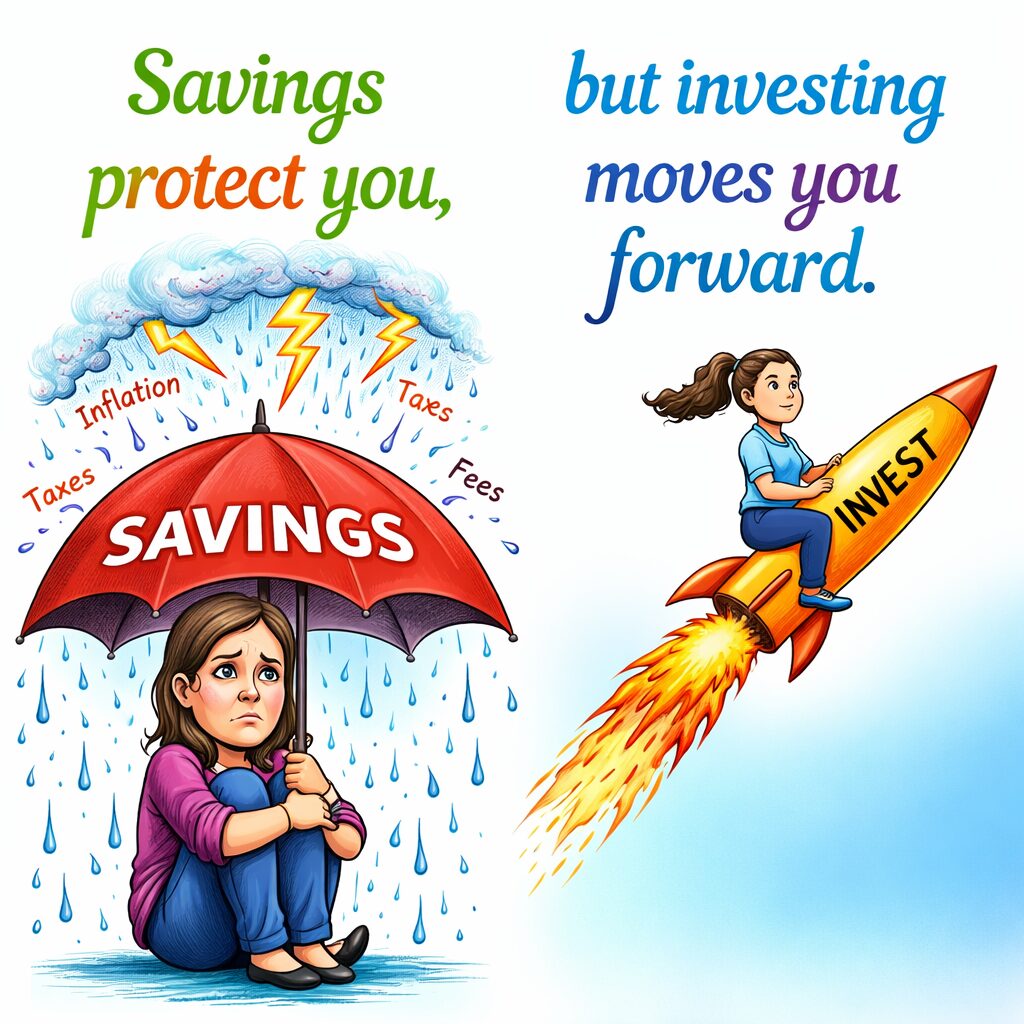
Understanding the difference between savings and investing is the first step toward financial success. Savings protect your money and provide liquidity for emergencies or short-term goals, while investing aims to grow your wealth over time through calculated risk. Combining both strategies wisely helps you build financial security today while steadily moving toward long-term wealth.

Savings vs Investing Explained Simply
Savings involve keeping money in low-risk instruments such as savings accounts or fixed deposits, where safety and easy access are priorities. Investing means putting money into assets like stocks, mutual funds, or bonds with the expectation of higher returns. Savings offer peace of mind, while investing helps beat inflation and grow wealth for long-term goals.
Savings vs Investing Comparison
The key differences between savings and investing lie in risk, return, and purpose. Savings offer low risk and predictable returns but limited growth potential. Investing carries higher risk but historically provides better returns over time. Savings are ideal for short-term goals, while investing is designed for long-term objectives like retirement, education, or wealth creation.
Trusted Examples of Savings
1 High-Yield Savings Accounts –
High-yield savings accounts offer significantly higher interest rates than standard savings accounts while keeping your money accessible at any time. They are ideal for building an emergency fund or saving for short-term goals. With minimal risk and FDIC insurance (in many countries), these accounts provide safety and steady growth, making them a reliable choice for conservative savers.
2 .Certificates of Deposit (CDs) –
CDs are time-bound deposits that pay a fixed interest over a specific period, ranging from months to years. They are a low-risk way to earn better returns than a standard savings account. CDs are suitable for savers who do not need immediate access to funds, as early withdrawals often incur penalties, ensuring disciplined saving while preserving capital.
3 .Money Market Accounts –
Money market accounts combine moderate interest earnings with flexibility, often allowing check-writing and debit access. They are slightly higher-yielding than regular savings accounts but maintain low risk. Money market accounts are perfect for short-term goals, providing liquidity for emergencies while offering better returns than traditional savings, making them a practical choice for individuals and families seeking accessible growth.
4 .Emergency Funds –
An emergency fund is a dedicated savings reserve covering 3–6 months of living expenses. It protects against unexpected financial challenges, such as job loss, medical emergencies, or urgent home repairs. Keeping funds liquid in a high-yield account ensures immediate access without penalties, providing peace of mind. A strong emergency fund is the foundation of financial security before pursuing investments.
5 .Fixed Deposits and Recurring Deposits
– Fixed deposits (FDs) allow lump-sum deposits for a fixed tenure with guaranteed returns, while recurring deposits (RDs) enable regular monthly savings with interest. Both instruments are low-risk and help achieve specific short-term goals like vacations, weddings, or educational expenses. Their predictable growth, safety, and structured saving mechanism make them ideal for disciplined savers.
6 .Senior Citizen Savings Schemes –
Designed for retirees, senior citizen savings schemes offer secure, government-backed returns with attractive interest rates. They provide financial stability and predictable income during retirement, complementing pensions or other income sources. These schemes prioritize capital protection while ensuring steady growth, helping seniors maintain their lifestyle and meet healthcare or living expenses without risk of capital loss.
7 .Business Contingency Funds –
Business contingency funds are dedicated reserves set aside to manage unforeseen challenges such as sudden expenses, operational disruptions, or temporary revenue drops. These funds help small business owners maintain financial stability without compromising daily operations. Keeping money in liquid, low-risk accounts ensures immediate access, safeguarding the business from emergencies and reducing reliance on high-interest loans or credit lines.
Trusted Examples of Investing
1 . Stocks –
Stocks represent ownership in companies, allowing investors to share in profits through dividends and potential capital appreciation. Investing in stocks can offer high returns over time, especially if you choose companies with strong growth potential. While stock prices fluctuate in the short term, a well-researched, diversified portfolio can help maximize long-term wealth accumulation.
2 .Bonds –
Bonds are fixed-income investments where you lend money to governments or corporations in exchange for regular interest payments. They are generally lower risk than stocks and can provide predictable income streams. Bonds are ideal for balancing a portfolio, preserving capital, and reducing volatility, making them an essential component of a diversified investment strategy.
3 .Mutual Funds –
Mutual funds pool money from multiple investors to invest in a diversified portfolio of stocks, bonds, or other securities. Managed by professional fund managers, they simplify investing for beginners and reduce risk through diversification. Mutual funds are suitable for those who want professional management and steady long-term growth without the need to pick individual securities.
4 .ETFs (Exchange-Traded Funds) –
ETFs are collections of assets like stocks or bonds that trade on stock exchanges like individual stocks. They combine diversification with flexibility, often tracking indices or sectors. ETFs usually have lower fees than mutual funds and allow investors to buy and sell throughout the day, making them ideal for both long-term growth and tactical investing.
5 .Index Funds –
Index funds are low-cost investment funds designed to replicate the performance of a specific market index, such as the S&P 500. They offer broad market exposure, low fees, and consistent long-term returns. For investors seeking a hands-off approach, index funds are a powerful way to participate in overall market growth while minimizing individual stock risk.
6 .Real Estate –
Real estate investing involves purchasing property to generate rental income or benefit from property appreciation. Physical real estate can provide steady cash flow, tax advantages, and portfolio diversification. While it requires more management and upfront capital than some investments, it is a tangible asset that often holds value even during market fluctuations.
7 .REITs (Real Estate Investment Trusts) –
REITs allow investors to access real estate markets without owning physical property. By pooling investor money to purchase income-generating properties, REITs provide liquidity, regular dividends, and potential for capital appreciation. They are an excellent option for those seeking exposure to real estate while maintaining flexibility and ease of investment.
8 .SIPs (Systematic Investment Plans) –
SIPs enable investors to make recurring, fixed-amount contributions to mutual funds. This methodical approach develops long-term financial habits, minimises market timing risk, and makes use of compounding. SIPs are very helpful for novice investors who want to gradually increase their wealth without requiring a sizable initial investment.
9 .PPF (Public Provident Fund) & NPS (National Pension Scheme) –
PPF and NPS are tax-advantaged long-term savings schemes designed to encourage retirement planning. PPF offers secure, government-backed returns, while NPS allows market-linked investments for higher growth potential. Both options help build a retirement corpus while providing financial discipline and tax benefits.
10 .Gold Bonds and Precious Metals –
Investing in gold bonds or other precious metals can safeguard wealth against inflation and currency fluctuations. They provide portfolio diversification and act as a hedge during economic uncertainty. Unlike physical gold, gold bonds offer fixed interest and ease of investment, making them a secure addition to a balanced portfolio.
11 .Education Savings Accounts –
These accounts are designed to save for children’s education costs. Contributions grow tax-free, and withdrawals for qualified educational expenses are usually exempt from taxes. Investing in such accounts ensures long-term financial planning for your child’s future and can significantly reduce reliance on loans or debt.
12 .Annuities (Low-Risk Portion) – Annuities
provide a guaranteed income stream over a fixed period or for life. They are ideal for conservative investors seeking long-term financial security, particularly during retirement. While returns may be lower than market-based investments, annuities reduce uncertainty and provide predictable cash flow, complementing riskier investments.
13 .Robo-Advisors – Robo-advisors automate
investment decisions using algorithms based on your risk profile and goals. They are low-cost, beginner-friendly, and offer portfolio diversification without the need for deep financial knowledge. Robo-advisors are excellent for hands-off investors who want professional guidance and automated portfolio management at minimal fees.
14 .Sustainable/Ethical Investment Funds –
These funds invest in companies that meet environmental, social, and governance (ESG) criteria. They allow investors to grow wealth while supporting responsible practices. Over time, ESG funds may outperform traditional investments due to better risk management and alignment with evolving market trends and consumer values.
15 .Peer-to-Peer Lending Platforms (Low-Risk)
– P2P lending connects borrowers with investors, providing regular interest income. Carefully selected low-risk P2P loans can diversify a portfolio and offer returns higher than traditional savings instruments. While some risk exists, thorough research, diversification, and using reputable platforms can make P2P lending a valuable alternative investment.
When Should You Save vs Invest?
Saving is ideal for goals under three years or money needed urgently. Investing is best for goals five, ten, or twenty years away, where short-term fluctuations matter less. A balanced approach—saving for security and investing for growth—ensures you are protected today while building wealth for the future.
Common Mistakes People Make
Many people keep all money in savings, which loses value over time due to inflation. Others invest without an emergency fund, forcing withdrawals during market downturns. Chasing high returns without understanding risk, ignoring diversification, or trying to time the market are also common pitfalls. Awareness of these mistakes can help you make smarter financial decisions.
Savings vs Investing for Beginners
Beginners should first build an emergency fund covering 3–6 months of expenses. Once secured, start investing gradually using simple, diversified options like index funds or SIPs. Learning basic risk management, staying consistent, and avoiding emotional decisions matters more than timing the market or chasing high returns. Patience and discipline are essential for long-term success.
Is Savings Enough to Beat Inflation?
Savings alone rarely beat inflation over time. While they protect capital, returns often fail to keep up with rising prices. Investing introduces growth potential that preserves purchasing power. A thoughtful mix of savings and investments is the most practical way to manage inflation and ensure your money grows sustainably
Expert-Backed Rule for Balanced Finance
Financial experts recommend dividing income between spending, saving, and investing strategically. Maintain an emergency fund, allocate money according to goal timelines, and diversify investments across asset classes to reduce risk. This structured approach balances short-term security with long-term growth, helping you achieve financial stability while steadily building wealth.
Final Thoughts
Savings and investing are not competitors—they complement each other in a healthy financial plan. Savings protect you from uncertainty, while investing drives wealth growth over time. By understanding when to save and when to invest, and by using trusted strategies, you can build financial security and confidently achieve long-term financial goals.
About the Author
Rio is the creator of EMIChecker and writes educational content on EMI calculations, loans, investment concepts, and personal finance tools. Through practical guides and calculators, Rio aims to help readers better understand financial topics and make more informed decisions.
Financial Disclaimer
The information and calculators provided on this website are for educational and informational purposes only and should not be considered financial, investment, tax, or legal advice.
Calculator results are estimates based on the information provided and may vary due to individual circumstances and market conditions.
Always consult a qualified financial professional before making any financial decisions.