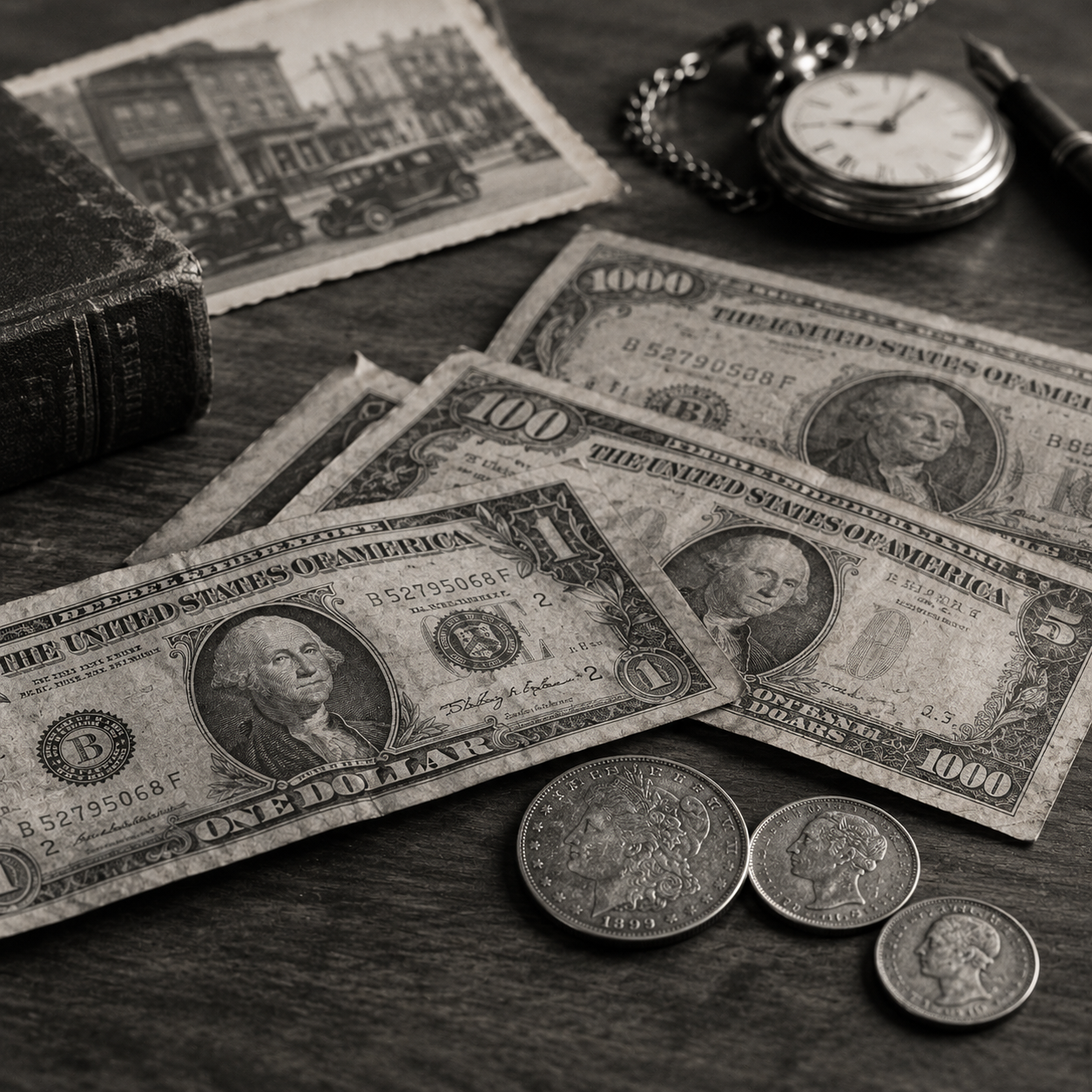
In 1899, a nickel bought a streetcar ride in Chicago, and the average nonfarm worker earned about $470 for the entire year. Today, a single dollar buys very little. The gap between 1899 dollars and today’s money is the story of more than a century of inflation, and it is striking when you put real numbers on it.
So how much are 1899 dollars worth today? Using CPI data through September 2026, $1 from 1899 has roughly the buying power of $40.60 today. That puts $100 at about $4,060 and $1,000 at about $40,595. In this guide to 1899 dollars, we look at what those amounts meant to ordinary Americans at the turn of the 20th century, what we can and cannot say about prices back then, and why the value of money has shifted so dramatically.

A quick refresher on the idea behind it all: inflation is the gradual rise in prices over time. When prices go up, each dollar buys less than it did before. Over a single year the change feels small. Over 127 years, it compounds into a difference of about forty to one.
How Much Are 1899 Dollars Worth Today? Starting With $1
Converting 1899 dollars to today’s money, one dollar from that year has the same purchasing power as about $40.60 in September 2026. The calculation divides the September 2026 CPI-U (336.940) by an 1899 index of 8.3, which gives a multiplier of about 40.6. Put another way, prices today are roughly 40.6 times higher than in 1899, and a modern dollar buys only about 2.5% of what a dollar bought then.
Different sources land in a narrow range. The Federal Reserve Bank of Minneapolis’s historical series gives about $40.19 using its own estimate for 2026, a gap of roughly 1%. We explain why in the calculation section below.
How Much Was $1 Worth in 1899?
It was real money. According to Historical Statistics of the United States, average annual earnings for nonfarm employees were about $470 in 1899, so one dollar was roughly 0.2% of a year’s pay. A nickel was the standard streetcar and elevated “L” fare within Chicago’s city limits, which means a dollar equaled 20 fares.
What Can $1 Buy Today?
A modern dollar buys far less than an 1899 dollar did. To match the purchasing power of one 1899 dollar, you would need about $40.60 in today’s money. That is a statement about the general price level, not about any single product.
How Much Is $100 From 1899 Worth Today?
A hundred 1899 dollars are worth approximately $4,060 today ($4,059.52 using September 2026 CPI-U). That is what $100 from 1899 would have to grow to in order to keep the same buying power across the whole CPI basket. It does not tell you how large the sum felt at the time, which is easier to judge by comparing it with the pay of the era.
How Big Was $100 in 1899?
With average nonfarm earnings of about $470 a year, $100 was roughly 21% of a typical year’s pay. For most households it was a significant amount, not pocket change. We have not quoted a shopping list for $100 because we could not verify reliable 1899 prices for most goods. The pay comparison is the most dependable way to understand its size.
How Much Purchasing Power Has $100 Lost?
Put another way, $100 today buys only about 2.5% of what it bought in 1899. That difference is what economists mean when they talk about the erosion of purchasing power.
How Much Is $1,000 From 1899 Worth Today?
A thousand 1899 dollars are worth roughly $40,595 today (about $40,192 using the Minneapolis Fed series). That adjusted figure shows how much money it takes today to match the same overall price level. How large $1,000 was in 1899 is easier to judge against pay, as the next section shows.
What Was $1,000 Worth in 1899?
At about $470 a year, $1,000 equaled a little more than two years of average nonfarm earnings. Whether it could buy a home, a farm, or a small business depended heavily on location and condition, and we did not find a reliable national figure, so we do not put a price tag on any of those here.
What Would $1,000 From 1899 Mean for Your Finances Today?
Roughly $40,600 of modern buying power. Because prices did not rise at the same pace for every product, that sum would stretch further for some purchases than for others. If you want to run your own numbers, the method is shown in the calculation section below.
1899 Dollars vs. Today’s Money: A Quick Comparison
This conversion table uses a single multiplier of about 40.595 (September 2026 CPI-U of 336.940 divided by an 1899 CPI of 8.3). Other calculators may differ by a few dollars.
| Amount in 1899 | Worth Today (Approx.) |
|---|---|
| $1 | $40.60 |
| $5 | $202.98 |
| $10 | $405.95 |
| $50 | $2,029.76 |
| $100 | $4,059.52 |
| $500 | $20,297.59 |
| $1,000 | $40,595.18 |
| $10,000 | $405,951.81 |
These figures will shift slightly as new monthly CPI data is released. Pre-1913 numbers are also estimates, because the government did not publish an official CPI before then.
What Could You Buy With $1 in 1899?
It is tempting to list dozens of 1899 prices, but reliable national price lists for that year are hard to find, and many numbers repeated online cannot be traced to a source. Below is what we can support with published data.
Food and Grocery Prices in 1899
Food is the best-documented part of the 1899 cost of living. The Bureau of Labor Statistics’ retail food index shows that food prices in 1899 were roughly flat against the 1890s average (a weighted index of 100.8, where the 1890 to 1899 average equals 100), and about 36% below the January 1913 reading of 157.9. The index tracks 15 staple foods in 39 industrial cities.
The BLS average-price series for individual groceries begins in 1913. Those are not 1899 prices, but they show the scale. In January 1913, BLS recorded eggs at about 37 cents a dozen, sugar at about 6 cents a pound, bread at about 6 cents a pound, and fresh milk at about 36 cents a gallon (roughly 9 cents a quart). Because food prices on average were about a third lower in 1899, these 1913 figures overstate 1899 prices, and we do not quote exact 1899 prices.
Transportation and Everyday Costs
In cities, streetcars were a common way to get around, and a nickel was the standard Chicago fare within the city. The fare structure could be unforgiving: when the Lake Street “L” reached Oak Park in April 1899, riders who crossed the city limit paid an additional nickel unless they bought a special transfer or a 20-ride ticket costing $1.00. Automobiles were still a rarity.
Clothing, Housing, and Other Costs
Clothing and rent varied by city, quality, and whether items were store-bought or made at home, so a single national 1899 price would be misleading, and we have not found a reliable one to quote.
We also avoid category-by-category “1899 to today” comparisons. Official BLS category indexes start much later than the overall CPI. The medical care index, for example, begins in the 1930s, so any figure that claims to show 1899 medical or housing inflation either mixes different start years or rests on weaker estimates. The overall CPI is the only measure used in this article for 1899 conversions.
What Were Wages and Salaries Like in 1899?
Low prices did not mean an easy life, and earnings go a long way toward explaining why.
How Much Did Workers Earn in 1899?
Historical Statistics of the United States, compiled by economist Robert Margo, estimates average annual earnings for nonfarm employees at $470 in 1899. Multiplying by the CPI factor, that is roughly $19,080 in today’s prices. This is only a price-level conversion; it is not a comparison with what workers earn today. Averages hide wide differences by industry, region, and occupation, so individual workers earned well above or below this figure.
That is a reminder that lower prices did not equal a comfortable standard of living, especially without modern medicine, safety protections, and conveniences.
How Big Were $100 and $1,000 Compared With a Year’s Pay?
Measured against average nonfarm earnings of $470, $100 was about 21% of a year’s pay and $1,000 was about 2.1 years of pay. That comparison, rather than a guess about what the money could buy, is the clearest way to see how large these sums were at the time.
Why Has the Value of Money Changed Since 1899?
The short answer is inflation. But it is worth understanding the longer story.
Understanding Inflation Over 127 Years
Inflation measures how quickly the general level of prices rises. Between 1899 and 2026, prices rose about 3,960% in total, an average of about 2.96% per year. That might sound mild, yet compounding does the heavy lifting. A 3% increase each year doubles prices roughly every 23 to 24 years, and over 127 years that adds up to a roughly 40-fold increase.
The path was not smooth. Prices rose sharply during World War I and the years after it, fell in 1921 and again in the early 1930s, climbed after World War II, and surged in the 1970s. Several forces shape these swings, and economists debate how much each one matters:
- Economic growth and demand: As economies expand and wages rise, spending and demand increase.
- Monetary policy: The Federal Reserve was created in 1913, and the dollar’s link to gold was loosened in stages, ending in 1971. Central banks influence the money supply and interest rates.
- Supply shocks and technology: New products, wars, and shortages push prices in different directions.
Why $1 Today Buys Less Than It Did in 1899
Today’s dollar buys far less than 1899 dollars did because prices overall have climbed dramatically. Meanwhile, the things we buy have changed too. A modern dollar cannot be compared one-to-one with an 1899 dollar for goods like electronics, medicine, or air travel, which did not exist or looked very different. This is one reason economists caution that long-term inflation comparisons are approximations.
How to Calculate the Value of 1899 Dollars Today
You can check the value of 1899 dollars yourself with any 1899 inflation calculator, or by hand. Our own US inflation calculator is one place to start. The formula is simple:
Today’s value = amount in 1899 × (CPI today ÷ CPI in 1899)
For $100: 336.940 ÷ 8.3 = 40.595, and 40.595 × $100 = $4,059.52.
- Pick a data source. The U.S. Bureau of Labor Statistics publishes the official CPI, with a comparable index starting in 1913. For earlier years, the Federal Reserve Bank of Minneapolis publishes a historical series that splices older estimates with modern CPI data, and in2013dollars.com has a ready-made 1899 calculator.
- Enter the amount. Type in the dollar figure you want to convert, such as $100.
- Select the years. Choose 1899 as the start year and the current year as the end point.
- Read the result. The calculator multiplies your amount by the ratio of the two CPI values.
Expect small differences between tools. The table below shows why two reputable sources give slightly different answers for $1,000.
| Method | 1899 index | 2026 index | $1,000 from 1899 |
|---|---|---|---|
| BLS CPI-U + 1899 estimate (main method) | 8.3 | 336.940 | $40,595 |
| Minneapolis Fed series | 25 | 1,004.8* | $40,192 |
*2026 value is an estimate. The BLS index base is 1982–84=100 (as used by in2013dollars.com); the Minneapolis Fed base is 1967=100.
The first method uses the latest monthly CPI reading. The Minneapolis Fed series uses annual averages, rounds its pre-1913 values to whole numbers, and marks its 2026 value as an estimate based on the change from the second quarter of 2025 to the second quarter of 2026. Different measures of inflation, such as consumer prices versus wages or GDP, can also produce different answers.
One more distinction: inflation-adjusted value is not the same as investment growth. A dollar adjusted for inflation shows what it could buy. A dollar invested in stocks or another asset would have grown according to returns, which can be much higher or lower than inflation. A future value table shows how a single dollar can grow at different rates over time.
Frequently Asked Questions
How much is $1 from 1899 worth today?
In today’s money, 1899 dollars are worth about 40.6 times their face value, so $1 is about $40.60 using September 2026 CPI-U data. Other methods give slightly lower figures, such as about $40.19 from the Minneapolis Fed series, so the safe summary is that $1 in 1899 has the buying power of roughly $40 today.
How much is $100 from 1899 worth today?
$100 in 1899 dollars is worth about $4,060 ($4,059.52 using the main method). The Minneapolis Fed series puts the same 1899 dollars at about $4,019.
How much is $1,000 from 1899 worth today?
A thousand 1899 dollars are worth about $40,595 ($40,595.18 using the main method). The Minneapolis Fed series values those 1899 dollars at about $40,192.
What could you buy with $1 in 1899?
With 1899 dollars, a single dollar equaled 20 nickel streetcar fares in a city like Chicago, and food prices were about a third below their January 1913 level, when BLS recorded eggs at about 37 cents a dozen. Because reliable national price lists for 1899 are scarce, we do not quote exact prices for individual items bought with 1899 dollars. A dollar was about 0.2% of the average nonfarm worker’s $470 annual earnings.
How much did a house cost in 1899?
There is no single reliable national figure for what 1899 dollars bought in housing. Prices varied enormously between growing cities and small towns or farms, and by size and condition. For scale, $1,000 equaled a little over two years of average nonfarm earnings.
Was $1,000 a lot of money in 1899?
Yes. In 1899 dollars, $1,000 equaled roughly two years of average nonfarm earnings. The inflation-adjusted equivalent, about $40,600, shows the same overall price level today. It says nothing about how that amount compares with today’s incomes.
How accurate are 1899 inflation calculations?
Conversions of 1899 dollars are estimates. There was no official CPI before 1913, calculators use different data splices and different months, and the basket of goods people buy has changed. Results from reputable tools typically differ by around 1% for 1899.
Conclusion: What 1899 Dollars Teach Us About Money
In today’s money, 1899 dollars are worth roughly 40.6 times their face value: $1 from 1899 is worth about $40.60, $100 is worth about $4,060, and $1,000 is worth about $40,595. Those multipliers reveal how powerful inflation can be when it compounds over generations.
But the numbers tell only part of the story. Lower prices in 1899 came with lower earnings and a very different standard of living. Looking at 1899 dollars through the lens of historical purchasing power helps us understand not just how prices have changed, but how our lives and economy have changed alongside them.
The next time you wonder what your money is worth, try running the numbers on a different year, such as 1900.
Sources and Methodology
Main conversion: September 2026 CPI-U (all items, not seasonally adjusted, 336.940) divided by an 1899 index of 8.3, as published by in2013dollars.com. The BLS release (October 14, 2026) reports the September 2026 CPI-U at 336.940, up 3.7% over twelve months. Pre-1913 values are historical estimates rather than official government figures. The Minneapolis Fed series is shown as a cross-check, not blended into the main figures. As an independent check on the 1899 index, the Fed’s value of 25 on a 1967=100 base converts to about 8.3 on the 1982-84=100 base (the 1982-84 average is 300.5 on that scale, and 25 ÷ 3.005 = 8.32).
- in2013dollars.com: Value of 1899 dollars today (CPI values and conversion table)
- U.S. Bureau of Labor Statistics: Consumer Price Index news release, September 2026
- Federal Reserve Bank of Minneapolis: Consumer Price Index, 1800–
- Historical Statistics of the United States (Margo): daily and annual earnings of employees, 1860–1929
- BLS Bulletin 125: Retail Prices, 1890 to April 1913 (food price index)
- BLS: Consumer Prices, 1913 and 2013 (January 1913 egg, sugar, bread, and milk prices)
- Chicago-L.org: Original fare systems (nickel fare, Oak Park example, 20-ride ticket)
About the Author
Rio is the creator of EMIChecker and writes educational content on EMI calculations, loans, investment concepts, and personal finance tools. Through practical guides and calculators, Rio aims to help readers better understand financial topics and make more informed decisions.
Financial Disclaimer
The information and calculators provided on this website are for educational and informational purposes only and should not be considered financial, investment, tax, or legal advice.
Calculator results are estimates based on the information provided and may vary due to individual circumstances and market conditions.
Always consult a qualified financial professional before making any financial decisions.