Car Insurance in Indiantown: Top 18 Insurance Companies Compared
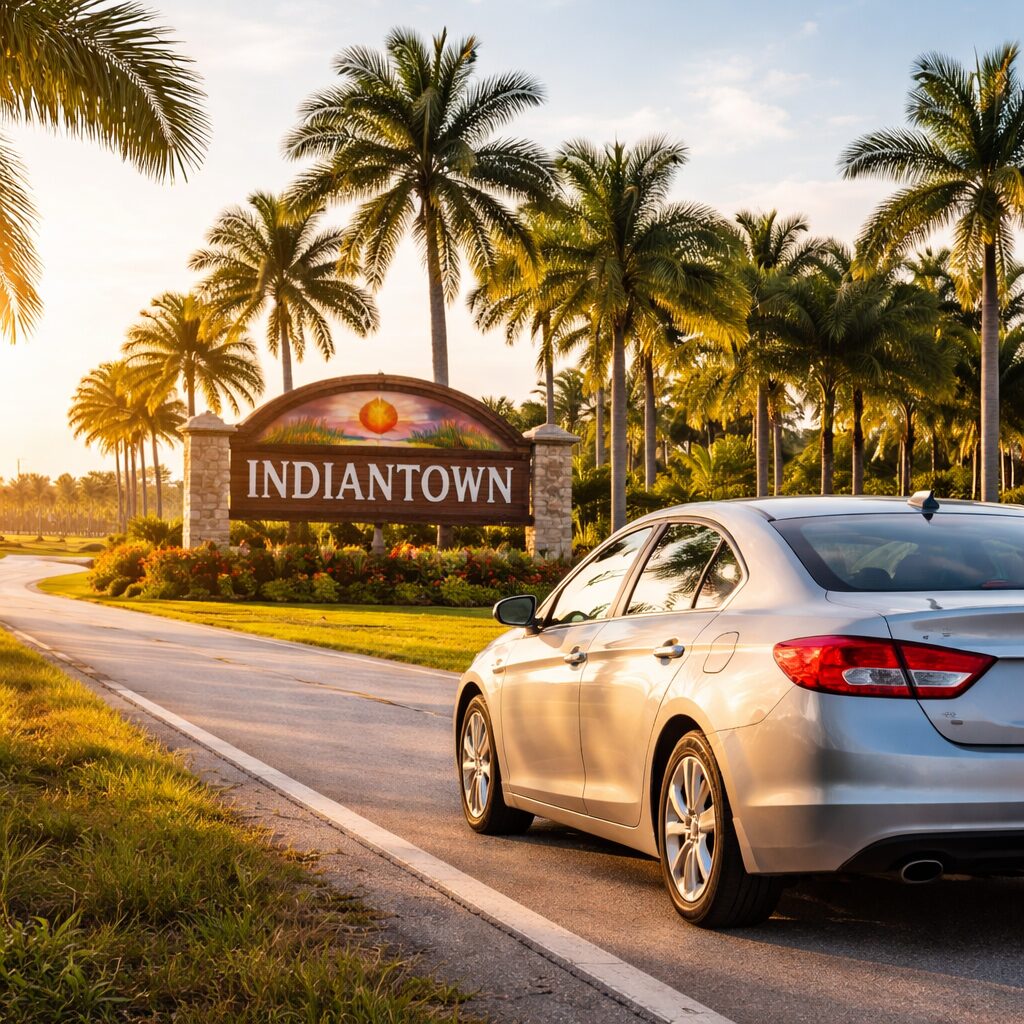
Finding the right car insurance in Indiantown means balancing Florida’s no-fault rules, rural driving conditions, and a market where rates run well above the national average. The Village of Indiantown is a small, agricultural Treasure Coast community in Martin County — incorporated in 2017 and home to roughly 6,500–6,800 residents — about 15 miles west of Stuart. That mix of rural roads, farm equipment traffic, and proximity to Lake Okeechobee’s storm exposure makes coverage choices here a little different than insuring a car in Miami or Orlando. This guide breaks down what Florida requires, what coverage actually costs, and which providers are worth a quote.

1. Why Car Insurance Matters for Indiantown Drivers
Car insurance is a legal requirement in Florida, but in a community like Indiantown it’s also practical protection against specific local risks. Rural roads here are shared with farm trucks, tractors, and agricultural equipment, which raises the stakes of even a minor collision. Add in Indiantown’s exposure to tropical storms and flooding near Lake Okeechobee, and comprehensive coverage starts looking less optional and more like basic financial planning. The right policy keeps a single accident, hailstorm, or hurricane from turning into a five-figure bill.
2. Florida’s Minimum Car Insurance Requirements
Florida is a no-fault state, and its minimum coverage rules reflect that. To legally register and drive a vehicle with four or more wheels, you must carry at least $10,000 in Personal Injury Protection (PIP) and $10,000 in Property Damage Liability (PDL). PIP covers your own medical bills and lost wages after an accident regardless of fault (typically 80% of medical costs and 60% of lost wages, up to the policy limit), while PDL pays for damage you cause to someone else’s vehicle or property. Notably, Florida does not require bodily injury liability by law — but without it, an at-fault driver can be personally sued for damages beyond what PIP and PDL cover. Driving without the required minimums can lead to license and registration suspension, so letting a policy lapse is rarely worth the risk.
3. Types of Car Insurance Coverage, Explained
Beyond the state-mandated PIP and PDL, drivers can add several other layers of protection. Bodily injury liability covers injuries you cause to others if you’re sued after an accident. Collision coverage pays to repair or replace your own vehicle after a crash, regardless of fault, while comprehensive coverage handles non-collision events like theft, vandalism, flooding, or storm damage — relevant for a community this close to Lake Okeechobee’s hurricane corridor. Uninsured/underinsured motorist coverage is optional in Florida but worth serious consideration: industry estimates suggest roughly one in five Florida drivers carries no insurance at all, so this coverage protects you if you’re hit by someone who can’t pay.
4. What Affects Your Car Insurance Rate in Indiantown
Florida insurers weigh a mix of personal and vehicle-related factors when setting your premium: driving history, age, the vehicle’s make and model, annual mileage, marital status, and — in Florida specifically — a credit-based insurance score. Location matters too. Rural ZIP codes like Indiantown’s typically see less traffic density than Miami-Dade or Broward, which can mean fewer accident claims, but storm and flood exposure near Lake Okeechobee can push comprehensive premiums in the other direction. The most effective ways to manage your rate are still the basics: a clean driving record, an appropriate (not excessive) coverage level, and shopping multiple carriers rather than auto-renewing.
5. Average Cost of Car Insurance in Indiantown
Florida is consistently ranked among the most expensive states in the country for car insurance, largely due to its no-fault system, high rate of uninsured drivers, and hurricane-related claims. Statewide 2026 rate studies put full coverage somewhere in the $2,200–$3,800 per year range (roughly $180–$320 a month) and state-minimum coverage around $1,000–$1,700 per year (roughly $85–$140 a month) — the wide range reflects differences in methodology between rate-tracking firms, not a single “correct” number. There’s no published Indiantown-specific average, but rural communities tend to land below the inflated rates seen in dense metro areas, while still sitting above the national average because of Florida’s statewide no-fault rules. Getting a personalized quote is the only way to know your real number.
6. The 18 Best Car Insurance Companies Serving Indiantown
These are real, licensed carriers that write policies in Florida, grouped by what they’re actually best at — not just a list of logos.
Major national carriers
- GEICO — Repeatedly ranked among the cheapest options in Florida for both minimum and full coverage, with a strong app and a long list of stackable discounts.
- State Farm — Florida’s top-ranked insurer in several 2026 industry studies; the largest local agent network if you’d rather talk to a person than a chatbot.
- Progressive — Known for its Name Your Price tool and Snapshot usage-based program, and generally more willing to write policies for drivers with a rougher driving history.
- Allstate — Premiums run higher, but it consistently scores well for claims satisfaction and offers strong accident-forgiveness add-ons.
- Travelers — Frequently cited as one of the more affordable full-coverage options in Florida and a top national pick for budget-conscious shoppers in 2026 rankings.
- Farmers Insurance — In business since 1928, with solid bundling discounts if you’re also insuring a home or renting.
- Liberty Mutual — A highly customizable policy builder, useful for adding gap coverage, new-car replacement, or rideshare endorsements.
- Nationwide — Vanishing-deductible and accident-forgiveness programs that reward long-term, claims-free customers.
Membership and specialty carriers
- USAA — Open only to military members, veterans, and their immediate families, but it consistently ranks at or near the top nationally for price and claims service among those who qualify.
- AAA (The Auto Club Group) — Membership-based, and pairs auto coverage with AAA’s roadside-assistance network — genuinely useful on Indiantown’s rural stretches of road.
- The Hartford — Built around the AARP auto program for drivers 50 and older, with lifetime renewability and a disappearing deductible.
- Mercury Insurance — Named one of Florida’s top-rated carriers by U.S. News, and competitive for households insuring multiple vehicles.
- Auto-Owners Insurance — Sold only through independent agents rather than direct online, but it consistently posts strong customer-satisfaction scores nationally.
High-risk and non-standard specialists (useful after a violation, lapse, or SR-22 requirement)
- The General — Topped WalletHub’s Florida customer-satisfaction ranking; built specifically for drivers turned down by standard insurers.
- GAINSCO — A Florida-licensed non-standard carrier focused on state-minimum and basic liability policies for higher-risk drivers.
- Direct Auto Insurance — Storefront locations across Florida, commonly used for SR-22 filings and pay-as-you-go minimum policies.
- National General — A non-standard specialist (now part of Allstate) known for flexible payment plans and low down payments.
- Dairyland Insurance — Specializes in drivers with lapses, violations, or limited credit history, as well as motorcycle policies.
Exact rankings shift from one rate study to the next, so treat this as a shortlist to quote, not a final answer — your driving record, vehicle, and ZIP code will move the math more than brand name will.
7. Local, Independent Agencies in Indiantown
If you’d rather sit down with someone face-to-face, Indiantown has independent agency options right in town. GreatFlorida Insurance has a locally owned office on Warfield Boulevard that, as of this writing, carries a strong customer rating — a useful example of how an independent agent can shop multiple carriers on your behalf rather than selling just one brand. Working with a local agent can be especially helpful if you’re new to Florida’s no-fault rules, need to bundle a homeowner’s or farm policy alongside your auto coverage, or simply want someone local to call when you have a claim. As with any business listing, confirm current hours and contact details directly before visiting, since they can change.
8. Affordable Car Insurance Options in Indiantown
Affordable coverage in Indiantown usually comes down to matching your policy to your actual risk rather than chasing the single cheapest quote. Carriers like GEICO and Travelers are routinely near the top of Florida affordability rankings, but the better strategy is to request quotes from at least three to five companies — a mix of a major national carrier, a regional or membership option if you qualify, and one non-standard specialist if your record warrants it. Raising your deductible, paying in full instead of monthly, and bundling renters or homeowners coverage are also reliable ways to bring the number down without dropping required coverage.
9. Coverage Options for High-Risk Drivers
A DUI, at-fault accident, or lapse in coverage will raise your rate, but it won’t make you uninsurable. Non-standard carriers like The General, GAINSCO, Direct Auto, National General, and Dairyland specifically underwrite drivers that standard insurers turn down, including those who need an SR-22 filing to reinstate a license. Rates from these carriers run higher than a clean-record policy from GEICO or State Farm, but most offer a path to lower premiums over time as your record ages without new incidents — typically a meaningful drop after three years of clean driving.
10. Insurance Discounts You Can Actually Use
Most Florida insurers offer a similar core set of discounts: safe-driver and accident-free discounts, multi-policy bundling (auto plus home or renters), multi-vehicle discounts, good-student discounts for young drivers, low-mileage discounts, and discounts for safety features like anti-theft devices or advanced driver-assistance systems. Telematics programs — Progressive’s Snapshot, State Farm’s Drive Safe & Save, and similar usage-based programs from other carriers — can also lower your rate based on actual driving behavior rather than just demographics. None of these apply automatically; ask your agent or check your online account to confirm every discount you qualify for is actually applied.
11. How to Compare and Choose the Right Provider
Price is only one factor. Before committing, check each insurer’s complaint ratio with the Florida Office of Insurance Regulation or the National Association of Insurance Commissioners, look at third-party satisfaction scores (J.D. Power, WalletHub, or NerdWallet ratings are a reasonable starting point), and ask specifically how claims are handled after a hurricane or flood event, since that’s a realistic scenario in this part of Florida. A policy that costs slightly more but pays claims quickly and without a fight is often the better deal.
12. How to Get Car Insurance in Indiantown
Getting covered is straightforward: gather your driver’s license, vehicle registration or VIN, and current driving history, then request quotes either online directly from carriers, through a comparison site, or in person with a local independent agent. Compare at least three quotes at matching coverage levels (don’t compare a minimum-coverage quote to a full-coverage quote), confirm the effective date, and keep proof of insurance in the vehicle and accessible digitally, since Florida law requires you to produce it on request.
13. Common Mistakes to Avoid When Buying Car Insurance
The most common and costly mistake is comparing quotes at different coverage levels and assuming the cheaper one is the better deal. Others include carrying only the state minimums on a financed vehicle (most lenders require full coverage), skipping uninsured motorist coverage in a state where roughly 1 in 5 drivers is uninsured, and not re-shopping at renewal — loyalty rarely earns a Florida driver a lower rate on its own.
14. Tips to Lower Your Car Insurance Premium
Raising your deductible from $500 to $1,000 typically lowers your premium meaningfully, and paying your policy in full (rather than monthly with installment fees) often saves more on top of that. Bundling auto with renters or homeowners coverage, maintaining continuous coverage without lapses, enrolling in a telematics program if you’re a low-mileage or careful driver, and reviewing your policy every renewal rather than letting it auto-renew are the most reliable ways to bring your premium down without losing required protection.
15. Why Comparing Multiple Quotes Actually Pays Off
Insurers don’t price risk the same way — one carrier’s algorithm might penalize your ZIP code heavily while another barely weighs it, and the same is true for age, credit-based insurance score, and vehicle type. That’s why two drivers with identical records can get quotes that differ by hundreds of dollars a year from the same set of companies. Re-quoting every renewal, not just when you first buy a policy, is where most of the savings actually show up over time.
16. Why Customer Service and Claims Handling Matter
The real test of a car insurance policy isn’t the sign-up experience — it’s how the company behaves when you file a claim, especially after a storm when claim volume spikes across the whole region at once. Checking complaint data and claims-satisfaction scores before you buy, not after a bad experience, is the only way to know in advance whether an insurer’s day-to-day price advantage will hold up when it matters.
17. Conclusion
Choosing car insurance in Indiantown comes down to three things: meeting Florida’s $10,000 PIP / $10,000 PDL minimum, choosing coverage that actually matches your local risk (rural roads, storm exposure, an above-average share of uninsured drivers on the road), and comparing real quotes rather than assuming one brand name is automatically cheaper. Whether you land on a major national carrier, a local independent agency, or a non-standard specialist, the providers above are a legitimate starting point — the next step is getting actual numbers in front of you.
FAQs
1. Is car insurance in Indiantown legally required?
Yes — car insurance in Indiantown is required under Florida law for every registered vehicle with four or more wheels, with a minimum of $10,000 in Personal Injury Protection and $10,000 in Property Damage Liability. Driving without it can lead to license and registration suspension, regardless of where in the state you live.
2. How much does car insurance in Indiantown typically cost?
There’s no published Indiantown-specific average, but statewide 2026 data puts full coverage in Florida around $2,200–$3,800 a year and minimum coverage around $1,000–$1,700 a year, with rural areas often landing on the lower end of that range. Your actual cost for car insurance in Indiantown depends heavily on your driving record, age, and vehicle.
3. When shopping for car insurance in Indiantown, what’s the difference between PIP and bodily injury liability?
PIP covers your own medical costs and lost wages after an accident no matter who caused it — that’s the Florida-mandated piece of any car insurance in Indiantown policy. Bodily injury liability, which Florida doesn’t require by law, covers injuries you cause to other people if you’re found at fault and sued.
4. Does full coverage car insurance in Indiantown make sense for an older or paid-off car?
Not always. Full coverage (liability plus collision and comprehensive) is usually required if your car is financed or leased, but once a vehicle is paid off and worth less than a few thousand dollars, the annual premium for collision and comprehensive can approach the car’s value — at that point, many drivers scale their car insurance in Indiantown back to liability plus PIP/PDL only.
5. Can high-risk drivers still get car insurance in Indiantown?
Yes. Non-standard carriers such as The General, GAINSCO, Direct Auto, National General, and Dairyland specifically write car insurance in Indiantown for drivers with violations, accidents, or an SR-22 requirement. Premiums are higher, but most insurers offer rate reductions after a few years of clean driving.
6. What discounts can lower the cost of car insurance in Indiantown?
Bundling auto with renters or homeowners insurance and enrolling in a telematics/usage-based program tend to produce the biggest savings on car insurance in Indiantown, followed by good-student, low-mileage, and safety-feature discounts. These aren’t applied automatically — confirm with your agent or carrier that you’re getting every one you qualify for.
7. Does comprehensive car insurance in Indiantown cover hurricanes and flooding?
Yes. Comprehensive coverage handles non-collision damage to your vehicle, including flooding, wind, and falling debris from storms — relevant given Indiantown’s proximity to Lake Okeechobee. Liability-only and PIP/PDL-only car insurance in Indiantown does not cover this.
8. Can I switch car insurance in Indiantown providers at any time?
Yes, Florida doesn’t lock you into a policy term. Just line up your new policy’s effective date with your old one’s cancellation to avoid a coverage gap, and check whether your current car insurance in Indiantown provider charges an early-cancellation fee.
9. What documents do I need to buy car insurance in Indiantown?
A valid driver’s license, vehicle registration or VIN, and your driving history are the basics most insurers ask for. Having these ready speeds up getting an accurate car insurance in Indiantown quote rather than an estimate.
10. Is it better to buy car insurance in Indiantown from a national carrier or a local agent?
Neither is universally better — a national carrier’s app and pricing tools work well if you’re comfortable self-serving online, while a local independent agency selling car insurance in Indiantown can be more useful if you want a single point of contact who can shop multiple carriers and help with claims in person.
11. Why do car insurance in Indiantown quotes vary so much between insurers for the same driver?
Each company weighs risk factors — ZIP code, credit-based insurance score, vehicle type, claims history — differently in its pricing model. That’s why getting quotes from three to five providers, not just one, is the most reliable way to find your actual best rate on car insurance in Indiantown.
12. What happens if I let my car insurance in Indiantown coverage lapse?
Beyond the immediate risk of an uncovered accident, a lapse can lead to license and registration suspension in Florida, and most insurers will charge you a higher rate when you reapply for car insurance in Indiantown, since a lapse itself is treated as a risk factor.
Note: This article reflects publicly available insurance rate data and Florida insurance requirements available at the time of writing. Insurance premiums vary based on factors such as age, driving history, vehicle type, location, coverage selections, and insurer underwriting criteria. Always verify current rates, coverage options, discounts, and state requirements directly with the insurer or a licensed insurance professional before purchasing a policy.
About the Author
Rio is the creator of EMIChecker and writes educational content on EMI calculations, loans, investment concepts, and personal finance tools. Through practical guides and calculators, Rio aims to help readers better understand financial topics and make more informed decisions.
Financial Disclaimer
The information and calculators provided on this website are for educational and informational purposes only and should not be considered financial, investment, tax, or legal advice.
Calculator results are estimates based on the information provided and may vary due to individual circumstances and market conditions.
Always consult a qualified financial professional before making any financial decisions.