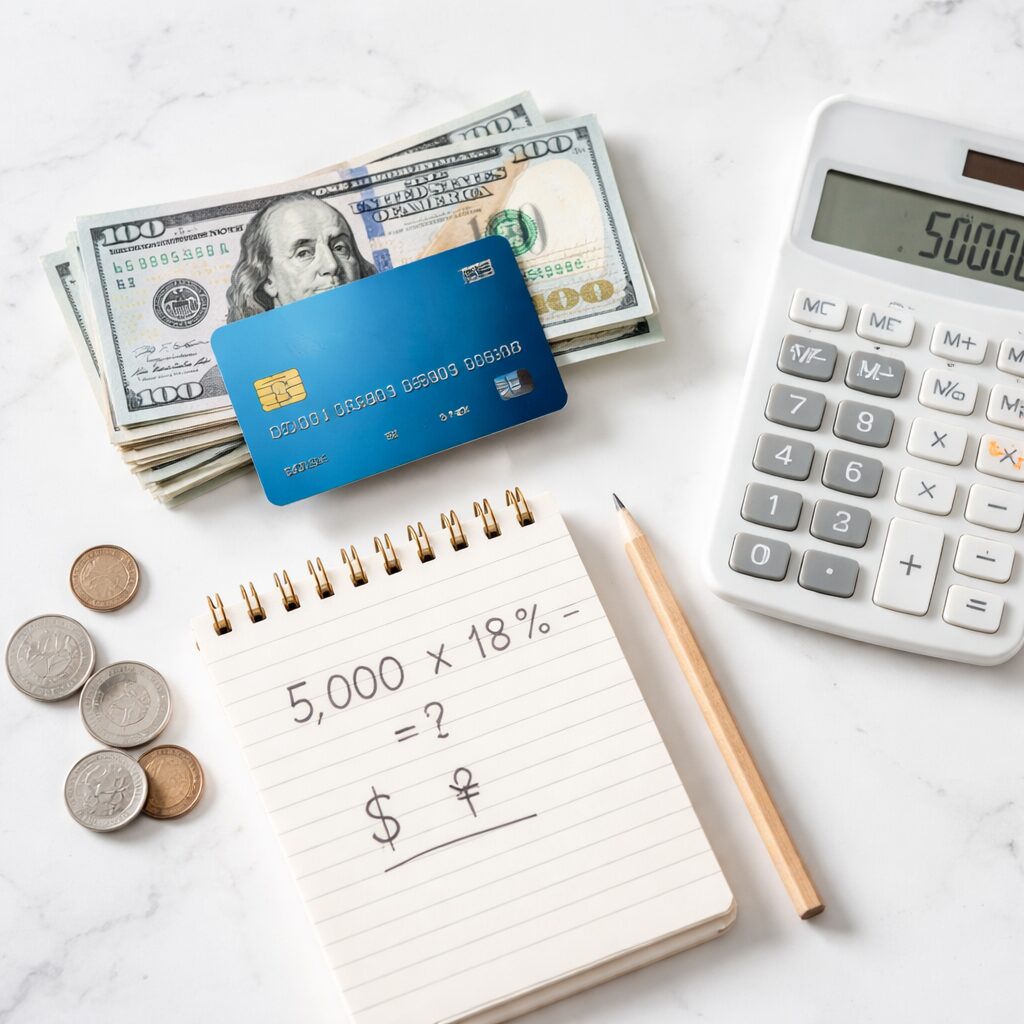
Credit card interest looks simple on the surface, but it quietly grows in the background and becomes expensive faster than most people expect. If you carry a $5,000 balance at 18% APR, you’re not just paying a fixed yearly fee—you’re paying interest that compounds daily. This means your balance increases slightly every single day, making it harder to get ahead unless you take control early.
How much interest on a $5000 credit card
1. Quick Answer: What You’ll Actually Pay
At 18% APR, a $5,000 credit card balance generates about $75 in interest per month if you carry the full balance. Over a year, that’s roughly $900 in interest without reducing the principal. However, because of daily compounding and changing balances, the real cost can be slightly higher. The key takeaway is simple: even a moderate APR can cost you hundreds annually if left unpaid.
2. What 18% APR Really Means
APR, or Annual Percentage Rate, represents the yearly cost of borrowing money, but it doesn’t mean interest is charged once per year. Credit cards apply this rate daily, which makes the effective cost higher over time. An 18% APR translates to a daily rate of about 0.049%, and that small percentage is applied to your balance every single day, quietly increasing your debt even when you’re not using the card.
3. How Interest Is Calculated on Your Balance
To understand your costs, you need to know how interest is calculated. First, the APR is divided by 365 to get the daily rate. Then, that rate is multiplied by your balance and the number of days in your billing cycle. For a $5,000 balance, this daily calculation adds up quickly, especially if no payments are made, leading to consistent balance growth each month.
4. Monthly Interest Breakdown on $5,000
In a typical 30-day billing cycle, your $5,000 balance at 18% APR results in approximately $75 in interest. This number can vary slightly depending on the number of days in the billing cycle and whether your balance changes during the month. Even though $75 may not seem huge, it adds up quickly, especially if you’re only making minimum payments and not reducing the principal significantly.
5. Yearly Cost of Carrying the Balance
If you carry the full $5,000 balance for an entire year without paying it down, you’ll pay close to $900 in interest. This is money that doesn’t reduce your debt—it simply goes to the lender. Over multiple years, this cost compounds further, making your original purchase far more expensive than intended and delaying your path to becoming debt-free.
6. The Minimum Payment Trap
Relying on minimum payments is one of the most common errors made by credit card users. It hardly lowers your balance yet maintains your account’s good status. Interest takes up the majority of your payment instead of the principal. Paying off $5,000 at this pace can take years, and you might have to pay thousands of dollars in interest alone, which would greatly increase your overall financial load.
7. How Daily Compounding Works Against You
Daily compounding means interest is calculated on your balance, and then the next day’s interest is calculated on the new, slightly higher balance. This creates a snowball effect where interest builds on itself. Even if the daily increase seems small, over weeks and months, it results in a noticeable rise in your total debt, making it harder to catch up without aggressive payments.
8. Real Interest Growth Over Time
If you don’t make significant payments, your interest cost continues to grow steadily. After six months, you could already pay around $450 in interest alone. After a year, it reaches around $900. This pattern shows how carrying a balance—even at a moderate APR—can become expensive quickly, reinforcing the importance of reducing your balance as soon as possible.
9. Practical Ways to Reduce Interest Quickly
The fastest way to reduce interest is to lower your balance. Paying more than the minimum each month has an immediate impact. Making multiple payments throughout the month can also reduce the average daily balance. Another effective strategy is transferring your balance to a 0% APR card or consolidating your debt at a lower interest rate, which can significantly cut down your total interest costs.
10. Impact of APR Changes on Your Debt
If your APR increases from 18% to a higher rate, your interest costs rise immediately. For example, at 24% APR, your monthly interest on $5,000 jumps significantly, making it even harder to pay down the balance. Variable APRs can change based on market conditions or missed payments, so maintaining a good payment history is crucial to keeping your interest rate under control.
11. Common Mistakes That Increase Interest Costs
Many people underestimate how quickly interest accumulates. Ignoring daily compounding, making only minimum payments, and missing due dates are some of the most common mistakes. Late payments can also trigger penalty APRs, which are much higher than standard rates. Avoiding these mistakes can save you hundreds or even thousands of dollars over time.
12. Final Thoughts: Take Control of Your Interest
Carrying a $5,000 balance at 18% APR may seem manageable at first, but the long-term cost tells a different story. Interest builds quietly but consistently, turning small balances into large financial burdens. The best approach is proactive—pay more than required, reduce your balance quickly, and avoid letting interest work against you. Small actions today can save you a significant amount in the future.
FAQS
1. How is the interest on a $5,000 credit calculated?
The interest on a $5,000 credit depends on the APR (Annual Percentage Rate) set by your credit card issuer. It is usually calculated daily based on your outstanding balance, and compounding can increase the total interest significantly if payments are delayed. Knowing this helps you plan repayments effectively.
2. Can I reduce the interest on a $5,000 credit?
Yes, you can reduce the interest on a $5,000 credit by paying more than the minimum monthly amount, using balance transfers to lower-rate cards, or negotiating a lower APR. Making timely payments and monitoring interest growth are key strategies to minimize long-term costs and manage debt efficiently.
3. What happens if I miss a payment on a $5,000 credit?
Missing a payment on a $5,000 credit can increase your interest charges because late fees are added, and your APR may rise. The unpaid balance continues to accrue interest daily, making it harder to pay off the debt. Staying current on payments is critical to controlling interest expenses.
4. How long will it take to pay off $5,000 credit with high interest?
The time to pay off a $5,000 credit depends on your monthly payments and the APR. Higher interest rates significantly extend repayment periods if you only pay the minimum. By understanding how interest on a $5,000 credit accumulates, you can create a plan to reduce the payoff timeline and save money.
5. Does paying more than the minimum reduce interest on a $5,000 credit?
Yes, paying more than the minimum each month directly reduces interest on a $5,000 credit. The larger payment decreases your principal faster, which lowers daily interest calculations. Over time, this strategy can save hundreds or thousands in interest fees and helps you become debt-free sooner.
6. How does APR affect interest on a $5,000 credit?
APR, or Annual Percentage Rate, directly affects interest on a $5,000 credit because it determines the percentage charged on your outstanding balance. Higher APRs mean faster accumulation of interest, while lower APRs save money. Knowing your APR allows you to calculate potential costs and plan payments effectively.
7. Is interest on a $5,000 credit compounded daily or monthly?
Typically, interest on a $5,000 credit is compounded daily, meaning each day your balance slightly increases based on the APR. Daily compounding can make interest grow faster than monthly compounding, so understanding how your credit card calculates interest is essential to managing your debt efficiently.
8. Can I transfer a $5,000 credit balance to lower interest?
Yes, transferring a $5,000 credit balance to a lower-interest credit card can reduce interest costs. Balance transfer cards often offer 0% or low introductory APRs. This strategy helps you focus on paying down the principal faster and reduces the overall interest paid on your credit balance.
9. How much interest will I pay on a $5,000 credit at 18% APR?
At 18% APR, the interest on a $5,000 credit can quickly add up if you only make minimum payments. Depending on how long the balance remains unpaid, you could pay hundreds in interest annually. Calculating your monthly interest helps you understand the cost of carrying a balance and plan repayments accordingly.
10. Are there fees in addition to interest on a $5,000 credit?
Yes, in addition to interest on a $5,000 credit, late payment fees, cash advance fees, and annual fees may apply. These fees can increase your total debt if not managed properly. Being aware of all charges ensures you control costs and minimize financial surprises.
11. How does making only minimum payments affect interest on a $5,000 credit?
Making only minimum payments prolongs repayment and increases interest on a $5,000 credit. Since interest is calculated on the remaining balance, a small payment mostly covers interest, not principal. Paying more than the minimum is critical to reducing interest accumulation and achieving faster debt repayment.
12. Can I calculate interest on a $5,000 credit myself?
Yes, you can calculate interest on a $5,000 credit yourself using the APR, daily balance, and number of days in the billing cycle. Online calculators or spreadsheet formulas help you estimate monthly interest and total payments, giving you control over your credit and repayment planning.
13. Does paying off part of the $5,000 credit early reduce interest?
Absolutely. Paying off part of a $5,000 credit early reduces the principal, which in turn decreases the interest charged daily. Early payments are one of the most effective ways to minimize the total interest paid and manage debt faster.
14. What is the difference between interest and APR on a $5,000 credit?
APR is the annual rate lenders charge for borrowing, while interest on a $5,000 credit is the actual cost incurred over time based on the balance and compounding frequency. Understanding this distinction helps in planning payments and comparing credit card offers to reduce costs.
15. Do promotional rates affect interest on a $5,000 credit?
Yes, promotional rates like 0% APR periods can temporarily reduce interest on a $5,000 credit. During the promo, little or no interest is charged, allowing faster repayment of the principal. Once the promotional period ends, regular APR applies, so planning ahead is essential to maximize savings.
16. How does a higher credit limit impact interest on a $5,000 credit?
A higher credit limit does not directly increase interest on a $5,000 credit, but carrying a larger balance can lead to more interest charges. Maintaining a balance close to the limit can increase your APR and affect your credit score, indirectly impacting borrowing costs.
17. Can automatic payments reduce interest on a $5,000 credit?
Yes, setting up automatic payments ensures timely repayment and prevents late fees, which indirectly reduces interest on a $5,000 credit. By avoiding missed payments, you control balance growth and minimize extra costs, helping you manage your credit more efficiently.
18. Does interest on a $5,000 credit affect my credit score?
Interest itself does not directly affect your credit score, but high balances and missed payments associated with interest on a $5,000 credit can. Maintaining low utilization and paying on time keeps interest manageable and supports a healthy credit score.
19. Is it better to pay off $5,000 credit in full each month?
Yes, paying off a $5,000 credit in full each month eliminates interest charges entirely. This avoids daily compounding, reduces debt stress, and keeps your credit utilization low, improving your overall financial health and saving money on interest.
20. Can I negotiate lower interest on a $5,000 credit?
Yes, you can negotiate lower interest on a $5,000 credit by contacting your lender and requesting a reduced APR, especially if you have a strong payment history. Lowering the interest rate decreases monthly charges, making debt repayment faster and more affordable.
About the Author
Rio is the creator of EMIChecker and writes educational content on EMI calculations, loans, investment concepts, and personal finance tools. Through practical guides and calculators, Rio aims to help readers better understand financial topics and make more informed decisions.
Financial Disclaimer
The information and calculators provided on this website are for educational and informational purposes only and should not be considered financial, investment, tax, or legal advice.
Calculator results are estimates based on the information provided and may vary due to individual circumstances and market conditions.
Always consult a qualified financial professional before making any financial decisions.